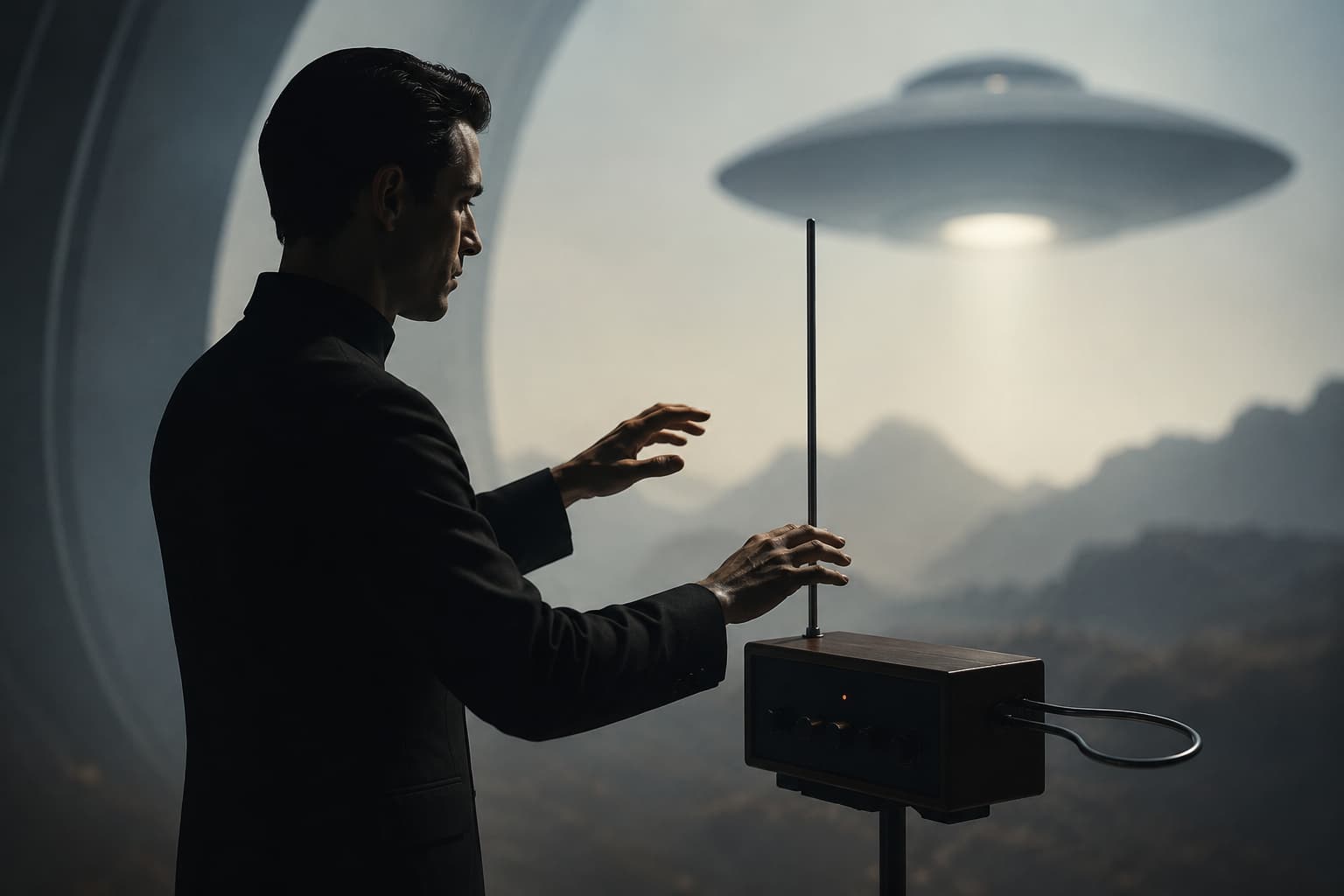
Close your eyes and picture a classic science fiction scene: a flying saucer descends through the clouds, a door hisses open, and an unearthly wavering wail rises on the soundtrack, a sound that is somehow both beautiful and deeply unsettling, like a voice from another world. That sound has become shorthand for the alien and the uncanny, burned into our collective imagination by decades of films. And almost no one realizes it comes from one of the strangest musical instruments ever invented, a device you play without ever touching it, born of a Soviet physics experiment a century ago. This is the theremin, and its story is as improbable as the sounds it makes.
The instrument was invented by a brilliant young Russian physicist named Lev Termen, known in the West as Leon Theremin. He was not trying to build a musical instrument at all. He was working on electronic sensing equipment, a proximity detector, when he noticed that the device produced a pitch that changed as his hand moved near it. Where another person might have seen a quirk to be engineered away, Theremin heard music. He refined the discovery into an instrument unlike anything before it: a box with two metal antennas, one sticking up and one curving out to the side. The performer stands before it and never touches it at all. Moving one hand toward the vertical antenna raises the pitch; moving the other hand near the horizontal loop controls the volume. The musician sculpts sound out of empty air, shaping invisible electromagnetic fields with nothing but the motion of their hands.
This makes the theremin famously, almost cruelly, difficult to play. Every other instrument gives you something to touch, a key, a string, a fret, a physical reference point that tells your fingers where the notes live. The theremin gives you nothing. The player must find each note in thin air from pure memory and muscle control, which is why one description calls it the instrument you play with your intentions, an act of conjuring notes out of the void. A great thereminist appears to be casting a spell, hands hovering and trembling in space, coaxing a melody from apparent nothingness.
The early life of the instrument was as dramatic as its playing technique. Theremin toured Europe demonstrating his creation to astonished, packed houses, reportedly sent abroad by Lenin himself to showcase the technological prowess of the young Soviet state. Audiences and classical composers were stunned by the sight of a man producing music from the air. Theremin then moved to the United States, patented his invention, and licensed it to a major electronics company, which produced a home model. Its release coincided almost exactly with the great stock market crash, and commercial success never arrived, but the instrument had already lodged itself in the culture’s imagination. In its first vogue, respected composers even wrote serious classical pieces for it, treating it as a kind of space-age violin.
Then something happened to the theremin’s own creator that sounds like pure fiction. Theremin was, by some accounts, spirited back to the Soviet Union, where he vanished into the state’s shadow world and was put to work in a secret laboratory designing eavesdropping devices for the intelligence services. The father of the world’s eeriest instrument spent years building spy equipment, including a famous covert listening device, before eventually resurfacing decades later, astonished to learn his invention had become famous on the other side of the world.
And famous it had. By the middle of the century the theremin had largely faded from the concert hall, its brief classical moment passed, and it might have slipped into obscurity entirely. What saved it was Hollywood. Film composers scoring the wave of thrillers and science fiction movies discovered that the theremin’s inherent eeriness was the perfect sonic tool for suggesting madness, dread, and the alien. Its quavering, disembodied tone appeared in the soundtracks of psychological thrillers and became inseparable from the era’s science fiction cinema, providing the trembling fanfare for spaceships and creatures from other planets. A critic once memorably described its sound as resembling a cello lost in a dense fog, crying because it does not know how to get home. That lonely, floating, not-quite-human quality was exactly what the movies needed, and the theremin became the official sound of outer space.
Its influence did not stop at film. The instrument enjoyed a second, briefer moment of fame in psychedelic pop, most memorably lending its otherworldly shimmer to a beloved Beach Boys hit, where a theremin-like tone gave the song its unforgettable, floating hook. But the theremin’s most profound legacy is one most people never think about. A young man named Robert Moog built and sold theremins as a hobbyist, and that fascination with electronic sound led him directly to develop the synthesizer, the instrument that would go on to define modern popular music. The circuitry Theremin pioneered, based on an elegant principle of blending radio frequencies, became the foundation for the analog synthesizers that followed. In a very real sense, nearly all electronic music descends from that accidental discovery in a Petrograd laboratory. The theremin was not a dead end but the very first branch of an enormous family tree.
It would be wrong to call the theremin truly forgotten today. A dedicated community of virtuosos still performs on it, documentaries have revived interest in its history, and modern versions are manufactured for a new generation of curious musicians. But it remains a beautiful outsider, an instrument most people have heard countless times without ever knowing its name or seeing it played. The next time a film wants to conjure the feeling of something not of this Earth, listen for that unmistakable electronic wail. It is the sound of a century-old accident, played by hands moving through empty air, still haunting us from the edge of the unknown.